Industrial Solid Waste
Olmsted County is committed to its continued waste management services, which are critical to maintaining its public health and safety. The County Environmental Resources Department is aligning staff to continue providing our customers the expected service through our Industrial Solid Waste Management Program.
Industrial solid waste is defined as waste generated by businesses from an industrial or manufacturing process or non-manufacturing activities managed as a separate waste stream. Businesses that utilize manufacturing or industrial processes or that are service or commercial establishments are likely to produce industrial solid waste. This is a special classification of non-hazardous, non-household waste that requires, by state law, special evaluation to determine the proper disposal method.
Generators of industrial solid waste are responsible for evaluating the waste and demonstrating that it is non-hazardous, either by documentation of the waste's characteristics and/or by laboratory testing.
The cost for disposal of industrial waste is the same as for other types of solid waste. Call 507 328-7070 for more information and requirements.
Common types of industrial solid waste from businesses are:
Animal remains & Carcasses - Category 26
Special Disposal Conditions
Pets: Cremation is the preferred method. Livestock: Rendering services or burial are the preferred methods. Wildlife & Road Kill: The MN Department of Natural Resources does not allow salvaging of animals without a permit. The Kalmar Landfill accepts furbearers, deer and other wildlife/road kill if other disposal options are not available (see below for explanation). Wild Game: Rendering is the preferred disposal method.
Generator Requirements
Deliver the carcass to the appropriate facility, as outlined above, only after obtaining necessary permits (if any), gaining appropriate approvals, and making facility-specific delivery arrangements.
Procedures
Typical Delivery types
Carcasses and large animal parts
Disposal
A. Pets: The preferred method for handling pet remains is to have the animal cremated. Contact a small animal veterinarian for guidance. Within the City of Rochester, the Rochester Animal Control Department (507-328-6960) is responsible for stray animals.
B. Farm Animals/ Livestock: If the animal meat is fresh (i.e., deceased for less than two days and/or without the distinct odor of decay), the owner should first try to contact a local rendering company to accept and/or collect the animal. If rendering is not an option, an animal may be burned or buried according to Minnesota Pollution Control Agency rules (Minnesota Administrative Rules, Chapter 1719). If farm livestock is found in water (in a creek, stream, or lake) or if on-site burial is not an option, the Minnesota Board of Animal Health must be contacted for assistance (651-296-2942).
C. Wildlife & Road Kills: Disposal of wildlife remains is complicated by the existence of federal and state laws that apply to game and non-game wildlife in addition to jurisdictional issues.
- Furbearers (raccoon, fox, opossum, badger, muskrat, beaver, otter, mink, etc.) must be tagged with a possession permit from the Department of Natural Resources (even if found dead). If the person possessing the animal does not wish to obtain a permit, the animal must be buried at the Olmsted County Kalmar Landfill (which operates Monday through Friday, 8:00 a.m. to 3:30 p.m. and may be contacted at 507-285-8515). NO salvaging of the animal will be allowed without a DNR permit.
- Federally protected birds are illegal to possess (even if found dead) and require proper disposal to a licensed facility. This includes raptors like eagles, falcons, hawks, and owls.
- Deer and any other wildlife/road kill are handled differently depending on whether their meat is fresh and salvageable or decayed. (Deer killed by a motor vehicle on a public road must be removed by the road authority).
- FRESH: If the animal meat is fresh, land disposal of the animal can usually be avoided. Road-killed deer may be collected by any interested person after obtaining a permit, at no charge, from the Minnesota Department of Natural Resources, the Olmsted County Law Enforcement Center, or the Minnesota State Patrol office. Any other person responsible for the disposal of any road kill should contact the Olmsted County Oxbow Park (507-775-2451). If this facility is unable to accept the carcass, it may be taken directly to the Kalmar Landfill.
- DECAYED: If the dead animal is beyond salvaging, is small and found within the City of Rochester, contact the Rochester Animal Control Department (507-328- 6960). If it is a large dead animal beyond salvaging, or a small, non-salvageable animal found outside the City of Rochester, the carcass may be taken directly to the Kalmar Landfill.
D. Wild Game: Hunters should dress large wild game animals in the field. Only a small amount of animal parts, including remains from home butchering, may be added to municipal solid waste from any household. Large carcasses or large amounts of body parts should be rendered. If this is impossible, they may be delivered directly to the Kalmar Landfill as described above.
Special Generator Requirements
Deliver the carcass to the appropriate facility, as outlined above, only after obtaining necessary permits (if any), gaining appropriate approvals, and making facility-specific delivery arrangements.
Asbestos Containing Material (ACM)
Disposal Requirements
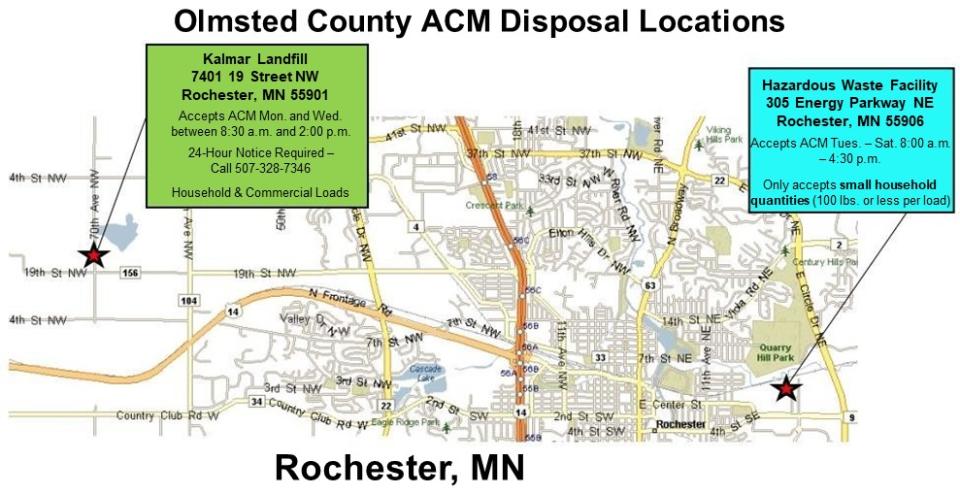
Asbestos Containing Material (ACM) is accepted at the Hazardous Waste Facility and Kalmar Landfill. The Hazardous Waste Facility only accepts small household quantities of ACM: (no more than 100 pounds per load) and no individual bag heavier than 25 pounds. The Kalmar Landfill accepts household and commercial loads of ACM. At the time of disposal, an “Asbestos Containing Material Transport and Disposal Manifest” form must be completed by the applicant and preapproved by Olmsted County staff. If appropriate county personnel are present at the time of delivery, the manifest can be completed at the disposal location. These forms are available at the Olmsted County Environmental Resources Department located at 2122 Campus Drive SE Suite 200, Rochester, MN 55904. Please note that waste loads that do not have the proper documentation will be rejected.
All ACM (friable or non-friable) accepted by the county must be packaged in drums or in one six-ply or two three-ply plastic bags/sheeting totaling no less than 6-millimeters (mil) in thickness. Friable asbestos is only accepted at the Kalmar Landfill. Friable asbestos should be adequately wetted/dampened using a low pressure, fine water spray to prevent blowing of asbestos fibers, should the plastic wrapping/drum break during transport. Containers of ACM must be closed, without holes, rips or tears, and have no visible emissions emanating. Loose asbestos will not be accepted by Olmsted County. Olmsted County staff will inspect the waste containers at the facility. If containers are not intact and appropriately labeled (see the ACM Disposal Checklist for further details), they will be rejected. The load must only contain ACM and cannot be mixed with other construction or demolition material.
ACM can be disposed of at the Kalmar Landfill by appointment on Mondays and Wednesdays between 8:30 a.m. and 2:00 p.m. A 24-hour notice is required. Please contact the Landfill at 507-328-7346. If additional hours are needed beyond Mondays and Wednesdays, please contact the Landfill (507-328-7346) to discuss possible options. Note: disposal appointments will be canceled if wind speeds at the landfill are greater than 10 miles per hour (mph). If your appointment is canceled due to the weather, landfill staff will make arrangements with you to reschedule. To ensure there are no delays in receiving your ACM load, please call the landfill the day of your appointment to confirm the site is still able to accept the material. Small household quantities (less than 100 pounds per load and no individual bag heavier than 25 pounds) are accepted at the Hazardous Waste Facility - Tuesday through Saturday, 8:00 a.m. to 4:30 p.m. Loads greater than 100 pounds will be redirected to the Kalmar Landfill for disposal. All asbestos containing safes will be redirected to the Kalmar Landfill.
ACM Background Information
Asbestos was generally used in building construction for fire-proofing purposes. The primary concern associated with handling asbestos wastes is exposure to airborne asbestos fibers. These fibers, if inhaled, can increase the risk of lung damage or cancer. Ordinarily, even a very small quantity of inhaled asbestos fibers may cause long-term respiratory side effects. Please note that new federal regulations (40 CFR Part 61) include more stringent requirements for labeling, manifesting and disposing of ACM in landfills. These regulations have been incorporated into the Olmsted County Industrial Solid Waste Management Plan.
Friable ACM is defined as asbestos material that when dry can be crushed, crumbled, pulverized, or reduced to powder by hand pressure. Friable asbestos fibers can easily escape into the air. Examples of friable ACM are sheet vinyl with a paper or felt backing, pipe and boiler insulation, duct insulation, and sprayed insulation. Friable asbestos is only accepted at the Kalmar Landfill.
Non-Friable ACM is any material containing more than one percent asbestos (as determined by Polarized Light Microscopy) that when dry CANNOT be crumbled, pulverized, or reduced to powder by hand pressure. Non-friable asbestos fibers are bound into a matrix and cannot easily escape into the air.
- Category I Non-Friable ACM – is pliable (not brittle), breaks by tearing rather than fracturing, and does not easily release asbestos fibers upon breaking. Examples include: packing material, gaskets, resilient floor covering and roofing products that contain greater than one percent asbestos and are in good condition.
- Category II Non-Friable ACM – any kind of non-friable ACM that is not covered under Category I. This type of ACM is NOT pliable, breaks by fracturing rather than tearing, and does release some asbestos fiber upon breaking. Examples include: cement asbestos boarding, Transite® siding, asbestos putties, asbestos sealants and adhesives.
The terms "friable" and "non-friable" are not necessarily meant to pertain to a material for its entire lifetime. Nonfriable ACM can become friable if it is damaged or worn enough.
Disposal Checklist
Supplies for packaging asbestos containing material (ACM) may be obtained at local hardware stores and home retail centers. Official Occupational Safety and Health Administration (OSHA) ACM dangerous material labels are available at safety supply stores or they can be purchased or printed from industrial safety websites.
Supplies
- Duct Tape (for sealing plastic bags or sheeting and affixing warning label)
- Heavy duty contractor grade plastic bags or plastic sheeting (total plastic thickness for packaging the material must be no less than 6-mil)
- Permanent black or red marker
- ACM danger warning labels (for friable ACM)
Packaging and labeling requirements differ depending on whether the ACM is friable or non-friable.
Asbestos Disposal Checklist
- All friable asbestos was adequately wetted/dampened using a low pressure, fine water spray to prevent blowing of asbestos fibers prior to the plastic being applied – precaution should the container become damaged during transport.
- Material is properly packaged – fully contained/sealed in a plastic drum or bagged/wrapped in one six-ply or two three-ply contractor grade plastic bags/sheeting totaling no less than 6-mil in thickness. All seams are completely sealed with duct tape. Items that have sharp edges may need additional layers to avoid puncturing or tearing.
- All friable asbestos packages/containers are properly identified with the ACM warning or OSHA label:
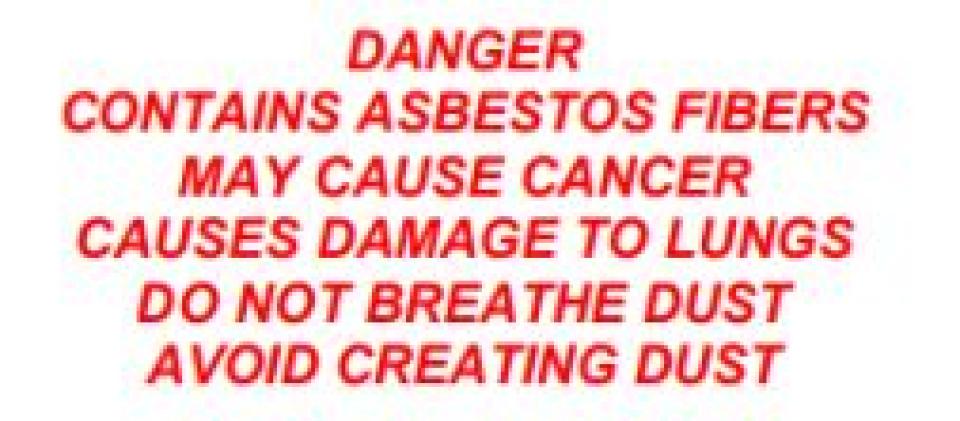
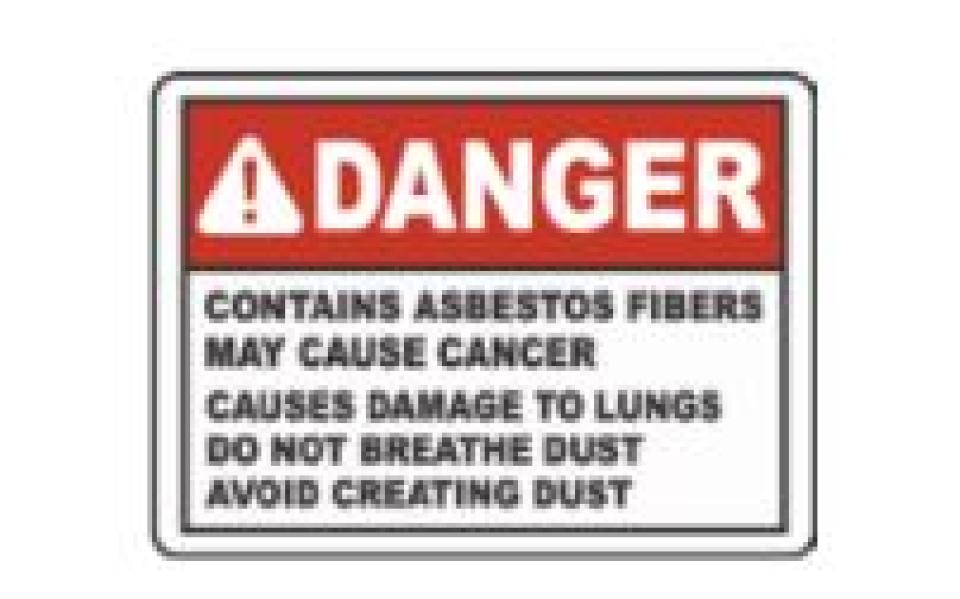
- The Asbestos-Containing Material Transport and Disposal Manifest is completed and pre-approved by Olmsted County staff. If appropriate county personnel are present at the time of delivery, the manifest form can be completed at the disposal location.
- For Kalmar Landfill Disposal – Appointment Date: ____and Time:_________
Please note: your disposal appointment may be canceled due to high wind conditions. To ensure there are no delays in receiving your ACM load, please call the landfill the day of your appointment at 507-328-7346 to confirm the site is still able to accept the material.
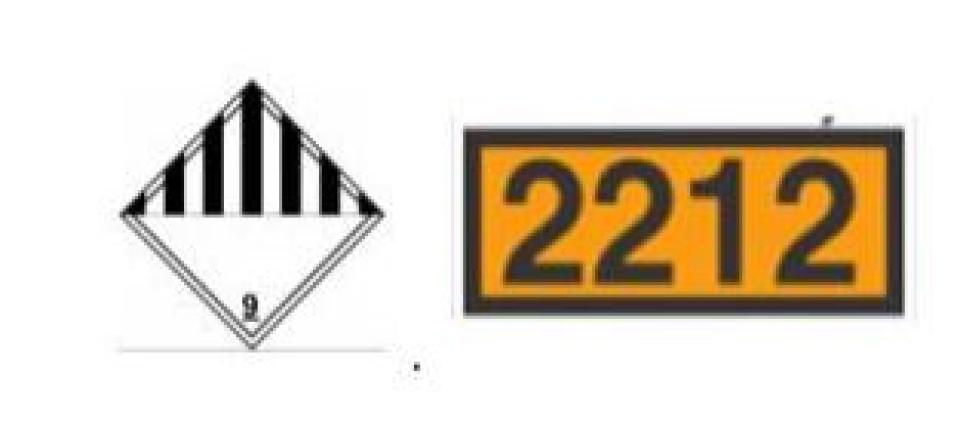
- Commercial Loads: An OSHA warning label is placed on the vehicle or container. At the landfill, the OSHA warning is required to be displayed during the disposal process. The landfill will also accept loads if they are marked with the U.S. DOT Class 9 Hazardous Waste placard with the ID # 2212, white-square on point device or orange panel. Vehicle signage is not required for homeowners transporting their own ACM
- The Asbestos-Containing Material Transport and Disposal Manifest is completed and pre-approved by Olmsted County staff. If appropriate county personnel are present at the time of delivery, the manifest form can be completed at the disposal location.
Tips for Securing Your Load
- Don’t rely on the weight of items to keep them secure in the truck bed or trailer. Place lighter items at the bottom of the load while packing.
- Secure all loads with ropes, bungee cords or straps. Tie larger items directly to the vehicle’s frame.
- When necessary, cover loads with sturdy plastic or a canvas tarp. Use a tarp that is large enough to completely cover the trailer or truck bed – a minimum of four inches should overlap the outer sides, front, and back of the trailer or truck bed.
- Keep the load level with the sides of the truck bed or trailer unless the load is secured. Don’t exceed the weight restrictions of the vehicle or the roadways.
- Before driving away, check the load to ensure that the cargo has been properly distributed and adequately secured. When transporting loads long distances, stop after traveling 25 miles and examine the load to ensure that it remains secure.
- Always dispose of trash at permitted solid waste disposal facilities.
Ashes- Category 8
Definition
Ash waste that is generated as a result of the combustion of municipal solid waste (MSW); hospital, medical, and infectious waste; coal; and other conventional fuels for the purposes of generating thermal and electrical power is accepted at the Kalmar Landfill.
Disposal
Approved waste materials will be directed to the Olmsted County Kalmar Landfill ash monofill disposal area.
Generator Requirements
To minimize airborne releases, the ash waste must be adequately wetted with noncontaminated water prior to arriving at the Kalmar Landfill. All ash waste loads must be delivered in covered containers. Testing is required (see below).
Procedures
Typical Delivery types
- roll-off containers
- other bulk containers
- dump trucks
Background
Ash waste that is generated as a result of the combustion of municipal solid waste (MSW); hospital, medical, and infectious waste; coal; and other conventional fuels for the purposes of generating thermal and electrical power is accepted under this category. Two types of ash waste are typically generated. Bottom ash waste is a coarse, dense material that forms in the furnace of boilers. Fly ash waste is a finer, less dense material removed from the flue gas in the heat transfer and air pollution control equipment.
Disposal Facility
Approved waste materials will be directed to the Olmsted County Kalmar Landfill ash monofill disposal area. The Kalmar Landfill Solid Waste Management Facility Permit (No. SW-355) allows for disposal of ash from incinerators, resource recovery facilities, and power plants to be deposited in the ash monofill disposal area.
Testing Requirements
Testing will mirror the requirements outlined in Minnesota Administrative Rules, part 7035.2910, as pre-scribed by the internal Olmsted County ash cell disposal requirements. This testing is required to ensure 1) the waste material is not a regulated hazardous waste and 2) the waste material is acceptable for disposal at an Olmsted County solid waste management facility. Ash waste generated from boilers and incinerators using only untreated, uncontaminated wood as a fuel will not require any analytical testing.
Documentation
A current, approved Industrial Solid Waste Evaluation Form must be on file with the Olmsted County Environmental Resources Department. The waste hauler must present a current, approved Non-Hazardous Industrial Solid Waste Tracking Form at the time of delivery. '
Special Generator Requirements
To minimize airborne releases, the ash waste must be adequately wetted (i.e., wetted with enough water to minimize fugitive emissions but without generating free liquids) with noncontaminated water prior to arriving at Kalmar Landfill. All ash waste loads must be delivered in covered containers.
Chemically Treated Wood- Category 16
Definition
Treated wood contains chemical preservatives (i.e., pesticides) to inhibit decay and extend the life of wood products. While treating wood lengthens its useful life up to 20 or 30 times longer than untreated wood in outdoor environments, some of the chemicals used in treating wood are hazardous to human health and the environment. To reduce the potential for treated wood products to have an adverse impact on human health and the environment, it is absolutely necessary to select, use, and dispose of treated wood products safely and appropriately.
Special Disposal Conditions
Chemically Treated Wood is accepted for disposal at Olmsted County’s Kalmar Landfill or Waste-to-Energy Facility depending on the chemical characteristics of the treated wood.
Generator Requirements
Businesses generating treated wood waste must evaluate the waste to determine if it must be managed as hazardous waste. A current, approved Industrial Solid Waste Evaluation Form must be on file with the Olmsted County Environmental Resources Department and an Industrial Solid Waste Tracking form must accompany each load for disposal.
Procedures
Typical Delivery types
- flatbed trailers
- roll-off boxes
Background
Treated wood contains chemical preservatives (i.e., pesticides) to inhibit decay and extend the life of wood products. While treating wood lengthens its useful life up to 20 or 30 times longer than untreated wood in outdoor environments, some of the chemicals used in treating wood are hazardous to human health and the environment. To reduce the potential for treated wood products to have an adverse impact on human health and the environment, it is absolutely necessary to select, use, and dispose of treated wood products safely and appropriately. The most common type of wood treatment involves saturating wood under high pressure in one of the following four chemical compounds: pentachlorophenol (PCP), typically used for utility poles; creosote, a tar-like substance used for railroad ties and construction pilings; copper chromium arsenic (CCA) or other arsenical preservatives containing arsenic and heavy metals; and other copper-containing treatments, such as ammoniacal copper quaternary (ACQ), copper azole, or ammoniacal copper citrate, which are formulated with less-toxic materials. As of December 31, 2003, the pressure-treated wood industry discontinued the use of CCA as the primary wood preservative used for most general consumer construction purposes. Minnesota Statutes, section 88.171, prohibits the open burning of chemically-treated wood products.
Disposal
The waste material will be directed to the Olmsted County Kalmar Landfill or the Olmsted Waste-to-Energy Facility (OWEF). Disposal of treated wood waste in demolition landfills is prohibited, since an unlined demolition landfill provides insufficient protection of ground water resources.
Testing Requirements
Businesses generating treated wood waste must evaluate the waste to determine if it is to be managed as hazardous waste. Treated wood originating from demolished structures is exempt from the hazardous waste requirements. Generators may not, however, mix the treated wood waste with other demolition waste. Treated wood waste, other than wood from demolished structures, must be evaluated for toxicity using the Toxicity Characteristic Leaching Procedure (TCLP). This testing is required to ensure 1) the waste material is not a regulated hazardous waste and 2) the waste material is acceptable for disposal at an Olmsted County solid waste management facility. If available, Material Safety Data Sheets (MSDS) must be provided.
Documentation
A current, approved Industrial Solid Waste Evaluation Form must be on file with the Olmsted County Environmental Resources Department. The waste hauler must present a current, approved Non-Hazardous Industrial Solid Waste Tracking Form at the time of delivery. Olmsted County does, however, exempt generators of less than 10 cubic yards of treated wood waste from the aforementioned documentation requirements.
Special Generator Requirements
If necessary, special generator requirements will be determined on a case-by-case basis.
Confidential Documents- Category 18
Definition
Some businesses, such as hospitals and clinics, generate confidential documents that require proof of destruction. In such cases, Olmsted County can provide waste generators with a manifest, in the form of a Non-Hazardous Industrial Solid Waste Tracking Form, that authenticates that an Olmsted County solid waste management facility received the confidential documents for disposal.
Special Disposal Conditions
It is Olmsted County’s policy to first refer generators of confidential paper documents to a private document destruction company. If the confidential documents do not consist of paper, or if there are circumstances that warrant or require witnessed disposal, then the confidential documents will be directed to the Olmsted Waste-to-Energy Facility (OWEF).
Generator Requirements
A current, approved Industrial Solid Waste Evaluation form must be on file with the Olmsted County Environmental Resources Department
Procedures
Typical Delivery types
- boxes
- drums
- bags
Background
Some businesses, such as hospitals and clinics, generate confidential documents that require proof of destruction. In such cases, Olmsted County can provide waste generators with a manifest, in the form of a Non-Hazardous Industrial Solid Waste Tracking Form, that authenticates that an Olmsted County solid waste management facility received the confidential documents for disposal.
Disposal
It is Olmsted County’s policy to first refer generators of confidential paper documents to a private document destruction company. If the confidential documents do not consist of paper, or if there are circumstances that warrant or require witnessed disposal, then the confidential documents will be directed to the Olmsted Waste-to-Energy Facility (OWEF).
Testing Requirements
In almost all most cases, analytical testing is not required; however, to ensure 1) the waste material is not a regulated hazardous waste and 2) the waste material is acceptable for disposal at an Olmsted County solid waste management facility, additional analytical tests may, under certain circumstances, be required.
Documentation
A current, approved Industrial Solid Waste Evaluation Form must be on file with the Olmsted County Environmental Resources Department. The waste hauler must present a current, approved Non-Hazardous Industrial Solid Waste Tracking Form at the time of delivery.
Special Generator Requirements
If necessary, special generator requirements will be determined on a case-by-case basis.
Contaminated Soils- Category 13
Definition
Contaminated soils may originate from various sources. A source may have areas contaminated with different products or combinations of products. Typically, these contaminated areas would be excavated from around a storage tank. The contaminants in question are most often those associated with gasoline, oils, and fuel oils, typically encountered near tank removal sites at locations such as filling stations, refineries, or other petroleum-related industries.
Disposal
Wastes mixed with inorganic materials (e.g., sand, soil, etc.) will be directed to the Olmsted County Kalmar Landfill. If combustible sorbents have been used, they may be directed to the Olmsted Waste-to-Energy Facility (OWEF).
Generator Requirements
See Required Testing below.
Procedures
Typical Delivery types
- dump trucks
- truck and semi-loads
- roll-off boxes
- small dumpsters
Background
Contaminated soils may originate from various sources. A source may have areas contaminated with different products or combinations of products. Typically, these contaminated areas would be excavated from around a storage tank. The contaminants in question are most often those associated with gasoline, oils, and fuel oils, typically encountered near tank removal sites at locations such as filling stations, refineries, or other petroleum-related industries. No PCB contaminated wastes will be accepted.
Disposal
Wastes mixed with inorganic materials (e.g., sand, soil, etc.) will be directed to the Olmsted County Kalmar Landfill. If combustible sorbents have been used, they may be directed to the Olmsted Waste-to- Energy Facility (OWEF).
Testing Requirements
Petroleum-contaminated soils must be evaluated using a Toxicity Characteristics Leaching Procedure (TCLP) for lead, unless it is a small one-time volume that is less than 5 cubic yards. Testing must include, at a minimum, the following parameters: benzene, toluene, ethyl benzene, xylene, (BTEX), and total petroleum hydrocarbons (TPH) – also, testing shall include gasoline range organics (GRO) for gasoline- contaminated sites, and diesel range organics (DRO) for oil-contaminated sites. The analyses and laboratory procedures outlined by the MPCA’s Petroleum Remediation Program will be utilized. To be accepted at the landfill, the material must meet the hazardous waste limits for lead and benzene, and the TPH concentration must be below 20,000 parts per million (ppm). If the leachate or groundwater concentrations for these parameters are already elevated for the secondary limits at the landfill, Olmsted County may consider restricting or eliminating wastes containing these compounds. For other types of contaminants, Olmsted County may require additional testing based on the possible contaminants involved. If available, Material Safety Data Sheets (MSDSs) of the contaminants present in the soil must be provided.
Documentation
A current, approved Industrial Solid Waste Evaluation Form must be on file with the Olmsted County Environmental Resources Department. The waste hauler must present a current, approved Non-Hazardous Industrial Solid Waste Tracking Form at the time of delivery.
Decontaminated Infectious Wastes- Category 29
Definition
Healthcare facilities (hospitals, skilled nursing facilities, veterinary clinics, etc.) routinely utilize steam sterilization (autoclaving) processes to decontaminate infectious materials. Autoclaves use saturated steam under high pressure to decontaminate infectious materials (i.e. cultures, cells, contaminated medical equipment, etc.) and to sterilize media, lab ware, and other items. Used properly, autoclaving technology ensures infectious waste, or potentially infectious waste, is safe for routine handling as a solid waste.
Disposal
Approved decontaminated infectious waste materials are routed to the Kalmar Landfill MSW cell or the Olmsted County Waste-to-Energy facility.
Generator Requirements
Generators of decontaminated infectious wastes must ensure that no free liquids are present and must present a signed Certification of Autoclave Treatment Form (see below).
Procedures
Typical Delivery types
- roll-off boxes
- drums and bags
- packer trucks
Background
Healthcare facilities (hospitals, skilled nursing facilities, veterinary clinics, etc.) routinely utilize steam sterilization (autoclaving) processes to decontaminate infectious materials. Autoclaves use saturated steam under high pressure to decontaminate infectious materials (i.e. cultures, cells, contaminated medical equipment, etc.) and to sterilize media, lab ware, and other items. Used properly, autoclaving technology ensures infectious waste, or potentially infectious waste, is safe for routine handling as a solid waste.
Disposal
Approved decontaminated infectious waste materials will be directed to the Kalmar Landfill MSW cell or Olmsted County Waste-to-Energy facility.
Testing Requirements
In general, no testing is required. However, generators of decontaminated infectious wastes that have a potential of containing free liquids (as defined by Minnesota Administrative Rules) must complete the Absence of Free Liquids Certification Form (see Page 3) and/or analyze a representative sample of the waste using analytical method SW-846 9095B, known as the “paint filter test.”
Documentation
A current, approved Industrial Solid Waste Evaluation Form must be on file with the Olmsted County Environmental Resources Department. Unless other arrangements have been made, the waste hauler must present a current, approved Non-Hazardous Industrial Solid Waste Tracking Form at the time of delivery. In addition, the hauler must present a signed Certification of Autoclave Treatment Form (see Page 4), which certifies that any previously infectious material has been rendered non-infectious prior to delivery. If completing and signing an Absence of Free Liquids Certification Form, the generator must complete and sign the certification form prior to the time of delivery.
Special Generator Requirements
Generators of decontaminated infectious wastes must ensure that no free liquids are present. Generators of decontaminated waste must present a signed Certification of Autoclave Treatment Form (see below), which certifies that any material has been rendered noninfectious prior to the time of delivery.
Deer and Elk Carcasses- Category 30
Definition
Deer and elk carcasses, as well as ash waste generated from the incineration of deer and elk carcasses, are considered an industrial solid waste if generated from any commercial processing operation or by a Minnesota Department of Natural Resources deer culling operation. Any deer and elk carcasses or carcass waste confirmed with chronic wasting disease (CWD) will not be accepted at any Olmsted County solid waste management facility.
Disposal
Approved deer and elk carcass wastes can be disposed of at the Olmsted County Kalmar Landfill.
Generator Requirements
Ensure that all free liquids are absent at the time of delivery. Deliveries must occur prior to 12:00 p.m. An approved Industrial Solid Waste Evaluation Form must be on file and a NonHazardous Industrial Solid Waste Tracking form must accompany each delivery load.
Procedures
Typical Delivery types
- roll-off boxes
- packer trucks
- drums and bags
Background
Deer and elk carcasses, as well as ash waste generated from the incineration of deer and elk carcasses, are considered an industrial solid waste if generated from any commercial processing operation or by a Minnesota Department of Natural Resources deer culling operation. Isolated carcass waste which is placed into the residential Mixed Municipal Solid Waste (MMSW) stream by hunters is considered to be household waste and is exempt from management by this Plan. Any deer and elk carcasses or carcass waste confirmed with chronic wasting disease (CWD) will not be accepted at any Olmsted County solid waste management facility. Olmsted County solid waste management facilities will not accept: 1) deer and elk carcasses potentially infected with CWD; 2) ash waste generated from the incineration of deer and elk carcasses potentially infected with CWD; or 3) any other waste that is potentially infected or contaminated with CWD. Recent research suggests that the most effective methods for disposing of CWD-infected waste include high temperature air curtain burners and chemical tissue digesters. At present, Olmsted County is not able to offer these preferred disposal options for CWD-infected or contaminated wastes. It is recommended that generators of CWD-infected or contaminated waste contact the University of Minnesota Veterinary Diagnostic Laboratory (UMVDL) and/or the Minnesota Pollution Control Agency (MPCA) to discuss disposal options. The UMVDL may be contacted at 612-625-8787 or via email at vdl@umn.edu. MPCA staff may be reached at 651-296-6300.
Disposal
Approved deer and elk carcass wastes will be directed to the Olmsted County Kalmar Landfill.
Testing Requirements
None
Documentation
A current, approved Industrial Solid Waste Evaluation Form must be on file with the Olmsted County Environmental Resources Department. The waste hauler must present a current, approved Non-Hazardous Industrial Solid Waste Tracking Form at the time of delivery.
Special Generator Requirements
Ensure that all free liquids are absent at the time of delivery for disposal (see below, Absence of Free Liquids Certification Form). Deliveries must occur prior to 12 p.m.
Electronic Wastes- Category 19
Definition
Electronic waste is any waste that has a circuit board or a cathode-ray tube (CRT). These products may contain lead, cadmium, or mercury at levels that are harmful to human health and the environment. They may include:
- televisions
- answering machines
- camcorders
- cameras
- central processing units (CPUs)
- compact disc (CD) players
- computers
- video display devices (projectors)
- video game systems
- digital video disc (DVD) players, televisions
- answering machines
Special Disposal Conditions
The Electronic equipment above is prohibited from disposal as municipal solid waste and is required to be properly recycled per Minnesota Statutes. The Olmsted County Recycling Center Plus (OCRC) may accept electronics for recycling. If the waste is not considered an electronic waste by the definition above, then the waste material may be directed to the Olmsted County Kalmar Landfill or the Olmsted Waste-to-Energy Facility (OWEF), depending on the waste material’s properties.
Generator Requirements
See below
Procedures
Typical Delivery types
- bulk
- drums
- Boxed
- bagged
Background
Electronic waste is any waste that has a circuit board or a cathode-ray tube (CRT), including, but not limited to, answering machines, camcorders, cameras, central processing units (CPUs), compact disc (CD) players, computers (including their peripherals), CRTs, digital video disc (DVD) players, electronic storage devices, game systems, fax machines, radios, satellite receivers, scanners, stereos (including receivers and speakers), telephones (rotary and cordless), televisions (including flat screens), typewriters, video cassette recorders (VCRs), video display devices (projectors), video game systems, and video equipment. CRTs and circuit boards within electronic devices may contain lead, cadmium, or mercury at levels that are harmful to human health and the environment. CRTs are considered the largest single source of lead in Minnesota's municipal waste, containing 5-8 pounds of lead per unit. Lead makes up approximately 20 percent of each CRT.
Disposal
Minnesota Statutes, section 115A.9565, prohibits the disposal of electronic products containing CRTs in municipal solid waste. Minnesota Statutes, section 115A.1310 established the Minnesota Electronics Recycling Act. This law requires “covered electronic devices" such as computers, peripherals, facsimile machines, DVD players, video cassette recorders, and video display devices to be recycled. The Olmsted County Recycling Center Plus (OCRC) is a MPCA registered collection site for electronic waste. If a device is not covered under Minnesota Statutes, sections 115A.9565 or 115A.1310, the waste material may be directed to the Olmsted County Kalmar Landfill or the Olmsted Waste-to-Energy Facility (OWEF), depending on the waste material’s combustion properties and the concentration(s) of any contaminant(s) present.
Testing Requirements
Unless complete documentation exists to characterize completely the waste material (using knowledge of the process that generates the waste and the raw materials that are used in the process), waste generators must evaluate the waste material using the Toxicity Characteristics Leaching Procedure (TCLP) for those pa-rameters that can reasonably be expected to be present. This testing is required to ensure 1) the waste ma-terial is not a regulated hazardous waste and 2) the waste material is acceptable for disposal at an Olmsted County solid waste management facility. If available, Material Safety Data Sheets (MSDSs) for any contaminants present must be provided.
Documentation
A current, approved Industrial Solid Waste Evaluation Form must be on file with the Olmsted County Environmental Resources Department. The waste hauler must present a current, approved Non-Hazardous Industrial Solid Waste Tracking Form at the time of delivery.
Special Generator Requirements
If necessary, special generator requirements will be determined on a case-by-case basis.
Empty Chemical Containers- Category 1
Definition
Any portable device in which a substance is stored, transported, treated, disposed of, or otherwise managed. Generally, containers of materials that would be considered nonhazardous waste when discarded can be disposed of through this program.
Special Disposal Conditions
Reusing, recycling or salvaging empty containers is the preferred method of disposal. The material will be directed to the Olmsted Waste-to-Energy Facility (OWEF) or the Olmsted County Kalmar Landfill depending on the container size and only after certification that the waste is non-hazardous.
Generator Requirements
- Prior to delivery, generators must trip-rinse any containers that previously held hazardous wastes or pesticides with a suitable cleansing agent and complete the “Certificate of Triple Rinsing” form
- The generator must cut holes in the top, bottom and sides to certify that the containers are free of liquids.
- Hazard or warning labels must be removed or blacked out.
- A current, approved Industrial Solid Waste Evaluation must be on file
- Industrial Solid Waste Tracking Forms and Certification of Non-Hazardous Status form must accompany each load for disposal.
Procedures
Typical Delivery types
- empty containers of metal or plastic composition
- occasionally contained in paper or plastic bags
Background
A container is defined as any portable device in which a substance is stored, transported, treated, disposed of, or otherwise managed (Title 40 CFR Part 260.10). The waste generator must evaluate the material that was or, potentially, still remains in the container. Containers of materials that would be considered non-hazardous waste when discarded may, in most cases, be managed as industrial solid waste. Generators of containers of materials that would be considered hazardous waste when discarded must consider the amount and type of residue remaining in the container in order to determine if the container is regulated as hazardous waste. Containers of materials that would be considered hazardous waste when discarded that do not meet the definition of “empty” (as defined by 40 CFR 261.7) must be managed as hazardous waste.
However, containers of materials that would be considered hazardous waste when discarded that meet the definition of “empty” (as defined by 40 CFR 261.7) may be disposed of as nonhazardous industrial solid waste. Containers that previously held a material that when discarded would be classified as acute hazardous waste are considered empty only after the containers have been triple-rinsed (using a solvent that is capable of removing all remaining residue) or the inner liners have been removed. The rinsate generated from the triple-rinsing must be used as a product or managed as acute hazardous waste. Containers that previously held acute hazardous waste that are NOT triple-rinsed must be managed as acute hazardous waste.
Disposal
Reusing, recycling, or salvaging empty containers is the preferred management method. If the containers cannot be reused, recycled, or salvaged, the Olmsted Waste-to-Energy Facility (OWEF) is the preferred management facility. Containers larger than 2 feet x 2 feet x 2 feet are unable to be processed at the OWEF but may, in most cases, be disposed at the Olmsted County Kalmar Landfill. The Minnesota Department of Agriculture (MDA) sponsors an Empty Pesticide Container Collection and Recycling Program; to learn more about the program and any restrictions that may apply, please contact the MDA Pesticide and Fertilizer Management division at 651-201-6121.
Testing Requirements
In most cases, analytical testing is not required. Under certain circumstance, additional testing may be required to ensure the waste material is not a regulated hazardous waste and is acceptable for disposal at an Olmsted County solid waste management facility. If available, Material Safety Data Sheets (MSDSs) of the container’s previous contents may be required.
Documentation
A current, approved Industrial Solid Waste Evaluation Form must be on file with the Olmsted County Environmental Resources Department. At the time of delivery, the hauler must present a current, approved Non-Hazardous Industrial Solid Waste Tracking Form, a completed, signed Empty Chemical Container Certification of Non-Hazardous Waste Status Form, and, if applicable, a completed, signed Certification of Triple Rinsing Form.
Special Generator Requirements
Prior to delivery, containers that previously held hazardous waste, acute hazardous waste, or pesticides must be triple-rinsed with a suitable cleansing agent. Containers must not contain any free liquids; must be rendered useless by cutting holes in the top, bottom, and two rows of three holes each on the sides; must have the lids or caps removed; and must have any hazard or warning labels removed or blocked out once the containers have been readied for disposal. Containers larger than five gallons must be trisected. Empty compressed-gas containers must be vented by puncturing, or other suitable means, to render them incapable of pressurization upon heating. If a valve is present, it is preferable to remove or open it. Containers that previously held compressed-gas are considered empty when the pressure inside the container approaches atmospheric pressure.
Resins- Category 11 (Epoxy, Fiberglass, Urethane, Polyurethane)
Definition
Waste materials in this category include products comprised of cured resins such as utility poles, containers, etc. The waste must be fully cured and hardened to be approved for disposal at an Olmsted County solid waste management facility. Fully cured wastes are not odorous, warm, or sticky to the touch.
Special Disposal Conditions
Waste materials are directed to the Olmsted County Waste-to-Energy Facility unless the waste consists primarily of fiberglass. To prevent the buildup of slag on OWEF’s grates, fiberglass material is directed to the Kalmar Landfill for disposal.
Generator Requirements
Waste materials that are odorous, contain free liquids, or are warm or sticky cannot be accepted. Any fiberglass dust must be adequately enclosed in containers. Empty containers must be punctured or possess removable lids.
Procedures
Typical Delivery types
- roll-off boxes
- small dumpsters
Background
Waste materials in this category must be fully cured and hardened in order to be approved for disposal at an Olmsted County solid waste management facility. Fully cured wastes are not odorous, warm, or sticky to the touch. Inhalation of fiberglass dust can be hazardous to human health, in particular to the respiratory system; therefore, waste materials that are not fully cured or hardened, or contain dust encapsulated inside a container, will not be accepted at any Olmsted County solid waste management facility in order to protect employee health. Waste materials in this category include products comprised of cured resins such as utility poles, containers, etc.
Disposal
Waste materials in this category will be directed to the Olmsted Waste-to-Energy Facility (OWEF) for disposal, unless the waste materials consist principally of fiberglass. To prevent a build-up of slag on OWEF’s grates, waste materials that consist primarily of fiberglass will be directed to the Olmsted County Kalmar Landfill for disposal. Generators are encouraged to explore the possibility of reusing or recovering energy from waste materials in this category.
Testing Requirements
Unless complete documentation exists to adequately characterize the waste material (through knowledge of the waste and its characteristics), waste generators must evaluate the waste using the Toxicity Characteristics Leaching Procedure (TCLP) for those parameters (i.e., volatile and semi-volatile organic constituents) that can reasonably be expected to be present. Under certain circumstances, additional testing may be required to ensure 1) the waste material is not a regulated hazardous waste and 2) the waste material is acceptable for disposal at an Olmsted County solid waste management facility. If available, Material Safety Data Sheets (MSDSs) must be provided.
Documentation
A current, approved Industrial Solid Waste Evaluation Form must be on file with the Olmsted County Environmental Resources Department. The waste hauler must present a current, approved Non-Hazardous Industrial Solid Waste Tracking Form at the time of delivery.
Special Generator Requirements
Waste materials that are odorous, contain free liquids, or are warm or sticky cannot be accepted. Generators must cure and harden fully all resins. Any fiberglass dust must be containerized adequately. Empty containers must be punctured or possess removable lids.
Food Waste- Category 25
Definition
Food wastes include products from local food manufacturers that do not meet production specifications or become out-of-date. The Department encourages the use of rendering services for all waste derived from meat processing operations.
Special Disposal Conditions
The Waste will be directed to the Olmsted Waste-to-Energy Facility (OWEF) or the Olmsted County Kalmar Landfill depending on the physical and chemical characteristics of the waste material.
Generator Requirements
No analytical testing is required but the generator must ensure the waste does not contain free liquids by completing the “Absence of Free Liquids Certification Form” (see example below).
Procedures
Typical Delivery types
- bags
- semi-loads
- drums
Background
Periodically, local food manufacturers have food ingredients and products that cannot be utilized in their manufacturing process because they do not meet production specifications or become out-of-date. When possible, these wastes will be directed to other food waste processing outlets, if they are available. Co-composting with yard waste will not be allowed because of potential vermin attraction. Sometimes, however, off-specification or out-of-date food wastes are not suitable for use at any outlet, or they cannot be directed to other outlets because of time constraints. In such instances, food wastes shall be processed or disposed of in accordance with the procedures outlined in the “Disposal” section.
Disposal
The waste material will be directed to the Olmsted County Waste-to-Energy Facility (OWEF) or the Olmsted County Kalmar Landfill depending on the physical and chemical characteristics of the waste material.
Testing Requirements
In general, no analytical testing is required; however, generators of food wastes that have a potential of containing free liquids (as defined by Minnesota Administrative Rules) must complete the Absence of Free Liquids Certification Form (see page 3) and/or analyze a representative sample of the waste using analytical method SW-846 9095B, known as the “paint filter test.”
Documentation
A current, approved Industrial Solid Waste Evaluation Form must be on file with the Olmsted County Environmental Resources Department. The waste hauler must present a current, approved Non-Hazardous Industrial Solid Waste Tracking Form at the time of delivery. If applicable, a signed Absence of Free Liquids Certification Form must accompany the waste at the time of delivery.
Special Generator Requirements
Ensure the waste does not contain free liquids. This includes the removal of all liquids from cans, bottles, and other containers.
Foundry Related Wastes-Category 7
Definition
Foundries are manufacturing facilities that fabricate metal castings using molten metals that are poured into pre-formed molds, most often consisting of sand. Foundry sand can often be reclaimed and reused in the casting process, however, heat and abrasion will eventually render the sand unsuitable for further use. Other industrial solid wastes that closely resemble the characteristics of foundry wastes, such as fire extinguisher powders, may be accepted in this category.
Disposal
Approved foundry wastes that cannot be recycled or reused will be directed to the Kalmar Landfill Municipal Solid Waste (MSW) disposal area.
Generator Requirements
All foundry wastes must undergo evaluation for metals using a Toxicity Characteristics Leaching Procedure (TCLP). Core and molding sands that incorporate binding agents must undergo TCLP analysis for any potential volatile/semi-volatile compounds. Material Safety Data Sheets (MSDS) must be provided.
Typical Delivery types
- sand cores and molds
- powders and dry vermiculite
- loose foundry sands
Background
Foundries are manufacturing facilities that fabricate metal castings using molten metals that are poured into pre-formed molds, most often consisting of sand. Once the metal has solidified the cast is separated from the sand in a shake-out process revealing the cast product. Sand cast molds used for casting ferrous metals are most often of the green sand type, consisting of high-quality silica sand, bentonite clay, sea coal, and a minute amount of water. Other chemically-bonded sand cast systems (utilized primarily for non-ferrous castings and constructing cores) involve the use of organic binding agents and chemical catalysts. More often than not, these organic constituents are non-hazardous in nature. Although foundry sand can often be reclaimed and reused in the casting process, heat and mechanical abrasion will eventually render the sand unsuitable for further use in the casting process. The preferred manner by which to manage foundry wastes is to find an alternative beneficial use for the waste material, such as aggregate and raw material replacement in the manufacture of hot asphalt mix and Portland cement, respectively; as construction site base material; and as road base material. Other industrial solid wastes that closely resemble the characteristics of foundry wastes, such as fire-extinguisher powders, may be accepted.
Disposal
Approved foundry wastes that cannot be recycled or reused will be directed to the Kalmar Landfill MSW disposal area.
Testing Requirements
Due to the fact that foundry wastes may have high metals concentrations, all foundry wastes must undergo evaluation for metals using a Toxicity Characteristics Leaching Procedure (TCLP). Core and molding sands that incorporate binding agents must undergo TCLP analysis for any potential volatile/semi-volatile compounds. Under certain circumstances, additional analytical tests may be required to ensure 1) the waste material is not a regulated hazardous waste and 2) the waste material is acceptable for disposal at an Olmsted County solid waste management facility. If available, Material Safety Data Sheets (MSDS) must be provided.
Documentation
A current, approved Industrial Solid Waste Evaluation Form must be on file with the Olmsted County Environmental Resources Department. The waste hauler must present a current, approved Non-Hazardous Industrial Solid Waste Tracking Form at the time of delivery.
Special Generator Requirements
Waste transporters must minimize the potential for generation of fugitive dust and airborne particulates during unloading.
Non-Recyclable Plastics- Category 24
Definition
Occasionally, commercial and industrial businesses will generate plastic waste materials that are unacceptable to recycling brokers. For example, used plastic products which cannot be adequately or economically cleaned would be rejected, as would plastics with incompatible resin content or those for which a recycling process has not yet been formulated. Typically, these materials have high energy content and are suitable for energy recovery. Olmsted County will accept only cured plastic waste materials.
Special Disposal Conditions
If the waste material cannot be reused or recycled, it will be directed to the Olmsted County Kalmar Landfill or the Olmsted County Waste-to- Energy Facility (OWEF) for final disposal, depending on the waste material’s combustion properties.
Generator Requirements
A current, approved Industrial Solid Waste Evaluation Form must be on file with the Olmsted County Environmental Resources Department. If the plastic material was used in an application that could result in it being potentially considered infectious waste, a letter must be on file with the Olmsted County Environmental Resources Department which certifies that any such material(s) will be de-contaminated prior to delivery.
Procedures
Typical Delivery types
- roll-off boxes
- drums and bags
Background
Occasionally, commercial and industrial businesses will generate plastic waste materials that are unacceptable to recycling brokers. For example, used plastic products which cannot be adequately or economically cleaned would be rejected, as would plastics with incompatible resin content or those for which a recycling process has not yet been formulated. Typically, these materials have high energy content and are suitable for energy recovery. Olmsted County will accept only cured plastic waste materials.
Disposal
If the waste material cannot be reused or recycled, it will be directed to the Olmsted County Kalmar Landfill or the Olmsted County Waste-to-Energy Facility (OWEF) for final disposal, depending on the waste material’s combustion properties.
Testing Requirements
In general, no analytical testing of the waste material is required; however, additional testing may be required under certain circumstances to ensure 1) the waste material is not a regulated hazardous waste and 2) the waste material is acceptable for disposal at an Olmsted County solid waste management facility. For example, if the plastic waste materials have once contained or been used to filter other materials, an assessment of all pertinent materials will be made, including reviewing the Material Safety Data Sheets (MSDSs) for all pertinent chemical substances. As a result of the initial assessment, analytical testing may be required.
Documentation
A current, approved Industrial Solid Waste Evaluation Form must be on file with the Olmsted County Environmental Resources Department. The waste hauler must present a current, approved Non-Hazardous Industrial Solid Waste Tracking Form at the time of delivery.
Special Generator Requirements
If, at any time, the plastic material was used in an application that could result in it being potentially considered infectious waste, a letter must be on file with the Olmsted County Environmental Resources Department which certifies that any such material(s) will be rendered non-infectious prior to delivery for disposal and specifying the method(s) used to accomplish this. Plastic waste materials that were previously considered infectious waste and have been decontaminated may be accepted in category 29.
Infectious Wastes- Category 15
Definition
The Mayo Clinic Hospital/Medical/Infectious Waste Incinerator (HMIWI) is the primary disposal option for infectious waste in Olmsted and Dodge Counties.
Special Disposal Conditions
On a case-by-case basis, the Kalmar Landfill can accept inert, bulky items (>3 ft. x 3ft. x 3 ft.), such as mattresses, beds, and couches that may have been exposed to blood, body fluids, or other infectious materials. The Kalmar Landfill will accept only inert, bulky items that, when compressed, do not release blood, body fluids, or other infectious materials.
Generator Requirements
If necessary, special generator requirements will be determined on a case-by-case basis (see below).
Procedures
Typical Delivery types
Bulky, inert items such as mattresses, beds and couches that may have been exposed to blood, body fluids, or other infectious materials.
Background
The Mayo Clinic Hospital/Medical/Infectious Waste Incinerator (HMIWI) is the primary disposal option for infectious waste in Olmsted and Dodge Counties.
Disposal
The Mayo Clinic HMIWI is the preferred disposal option for infectious waste in Olmsted and Dodge Counties. For information call 507-284-9400. However, on a case-by-case basis, the Kalmar Landfill can accept inert, bulky items greater than 1 cubic yard, such as mattresses, beds, and couches that may have been exposed to blood, body fluids, or other infectious materials. The Kalmar Landfill will accept only inert, bulky items that, when compressed, do not release blood, body fluids, or other infectious materials.
Testing Requirements
In general, no testing of the waste material is required; however, under certain circumstances additional testing may be required to ensure: 1) the waste material is not a regulated hazardous waste and 2) the waste material is acceptable for disposal at an Olmsted County solid waste management facility.
Documentation
A current, approved Industrial Solid Waste Evaluation Form must be on file with the Olmsted County Environmental Resources Department. The waste hauler must present a current, approved Non-Hazardous Infectious Solid Waste Tracking Form at the time of delivery.
Special Generator Requirements
The waste generator is responsible for adhering to all applicable provisions of Minnesota Administrative rules, part 7035.9120, and all other federal, state, and local laws and regulations that pertain to the management of infectious waste. Mattresses for disposal at the Kalmar Landfill will only be accepted wrapped in plastic. The Kalmar Landfill will accept only inert, bulky items that, when compressed, do not release blood, body fluids, or other infectious materials.
Ink Sludges and Solvents- Category 14
Definition
Businesses may produce many different types of ink waste in their manufacturing processes or as a result of the services they provide. Ink -related wastes must be thoroughly evaluated since they may contain metals or volatile organic compounds (VOCs) at or above regulatory limits. Solvent-containing wastes in the liquid form are not accepted at the Olmsted County Kalmar Landfill or the Olmsted Waste-to-Energy Facility (OWEF). Solvent-containing wastes can only be accepted when absorbed into a combustible material. Ink waste in sludge form must be in a solid or semi-solid form.
Special Disposal Conditions
In general, combustible ink wastes will be directed to the OWEF, while non-combustible ink waste will be disposed at the Kalmar Landfill.
Generator Requirements
If necessary, special generator requirements will be determined on a case-by-case basis. An “Absence of Free Liquids” form may be required (see below).
Procedures
Typical Delivery types
- ink sludges
- ink-contaminated cloth and paper
- ink-related solvent
- ink-contaminated scrapings and sweepings
Background
Businesses may produce many different types of ink waste in their manufacturing processes or as a result of the services they provide. Ink-related wastes must be thoroughly evaluated since they may contain metals or volatile organic compounds (VOCs) at or above regulatory limits. Solvent-containing wastes in the liquid form are not accepted at the Olmsted County Kalmar Landfill or the Olmsted Waste-to-Energy Facility (OWEF). Solvent-containing wastes can only be accepted when absorbed into a combustible material. Ink waste in sludge form must be in a solid or semi-solid form.
Disposal
Disposal is contingent on the waste’s combustion characteristics and what, if any, contaminants are present. In general, combustible ink wastes will be directed to the OWEF, while non-combustible ink waste will be disposed at the Kalmar Landfill.
Testing Requirements
Unless complete documentation exists to adequately characterize the waste material (through knowledge of the waste and its characteristics), waste generators must evaluate the waste using a Toxicity Characteristics Leaching Procedure (TCLP) analysis for those parameters (i.e., metals and volatile and semi-volatile organic constituents) that can reasonably be expected to be present. Waste generators may also be required to determine the waste material’s flash point and pH to determine the characteristics of ignitability and corrosivity. Generators of ink or solvent-related wastes that have a potential of containing free liquids (as defined by Minnesota Administrative Rules) must complete the Absence of Free Liquids Certification Form (see Page 3) and/or analyze a representative sample of the waste using analytical method SW-846 9095B, known as the “paint filter test.” This testing is required to ensure 1) the waste material is not a regulated hazardous waste and 2) the waste material is acceptable for disposal at an Olmsted County solid waste management facility. Any available Material Safety Data Sheets (MSDSs) must also be provided. Please note that MSDSs are only required to list ingredients that make up more than one percent of the product. Regulated chemicals in lesser amounts could still render the waste hazardous.
Documentation
A current, approved Industrial Solid Waste Evaluation Form must be on file with the Olmsted County Environmental Resources Department. The waste hauler must present a current, approved Non-Hazardous Industrial Solid Waste Tracking Form at the time of delivery. If required, the generator must complete and sign an Absence of Free Liquids certification form prior to the time of delivery.
Special Generator Requirements
If necessary, special generator requirements will be determined on a case-by-case basis.
Machining Wastes- Category 17
Definition
Machining operations conducted at machine shops, metal stamping facilities, and other metalworking operations typically generate various types of waste. Waste material generated from machining processes is a prime candidate for recycling if the waste is not co-mingled with other metals or otherwise contaminated.
Disposal
If the waste material cannot be re-used, recycled, or managed in another more beneficial manner, it will be directed to the Olmsted County Kalmar Landfill for final disposal.
Generator Requirements
Remove any free liquids from the machining wastes and hole-punch waste containers. Additional requirements are to be determined on a case-by-case basis. For required testing below.
Procedures
Typical Delivery types
- bulk
- drums
- bagged
Background
Machining operations conducted at machine shops, metal stamping facilities, and other metalworking operations typically generate various types of waste. Waste material generated from machining processes is a prime candidate for recycling if the waste is not co-mingled with other metals or otherwise contaminated.
Disposal
If the waste material cannot be re-used, recycled, or managed in another more beneficial manner, it will be directed to the Olmsted County Kalmar Landfill for final deposition.
Testing Requirements
Due to the fact that many machining operations (e.g., milling, turning, threading, filing, and grinding) require the use of solvents, coolants, degreasers, cutting fluids, and lubricants, it is essential that generators thoroughly evaluate their waste to determine if it is to be managed as a hazardous waste. Unless complete documentation exists to adequately characterize the waste material (using knowledge of the process that generates the waste and the raw materials that are used in the process), waste generators must evaluate the waste material using the Toxicity Characteristics Leaching Procedure (TCLP) for those parameters that can reasonably be expected to be present. This testing is required to ensure 1) the waste material is not a regulated hazardous waste and 2) the waste material is acceptable for disposal at an Olmsted County solid waste management facility. If available, Material Safety Data Sheets (MSDSs) for any contaminants present must be provided.
Documentation
A current, approved Industrial Solid Waste Evaluation Form must be on file with the Olmsted County Environmental Resources Department. The waste hauler must present a current, approved Non-Hazardous Industrial Solid Waste Tracking Form at the time of delivery.
Special Generator Requirements
Remove any free liquids from the machining wastes and hole-punch waste containers. Additional requirements are to be determined on a case-by-case basis.
Non-Combustible, Inert Wastes- Category 27
Definition
For the purposes of this category, non-combustible inert wastes are non-hazardous, noncombustible, non-biodegradable, and chemically-inert solid wastes that are not likely to decompose significantly. This may include: uncontaminated sand, soil, concrete, rubble, masonry, glass, pottery, ceramics, brick, tile, and remnants of metal from a manufacturing process or from non-manufacturing activities such as service and commercial establishments. When possible, non-combustible inert wastes are directed to other retail or reuse outlets.
Disposal
Non-Combustible, Inert Wastes are accepted for disposal at the Olmsted County Kalmar Landfill.
Generator Requirements
A current, approved Industrial Solid Waste Evaluation Form must be on file with the Olmsted County Environmental Resources Department (see below for more requirements)
Procedures
Typical Delivery types
- truck and semi-loads
- bulk transport
- individual pieces
Background
For the purposes of this category, non-combustible inert wastes are non-hazardous, noncombustible, non-biodegradable, and chemically-inert solid wastes that are not likely to decompose significantly. These wastes tend to have a negligible potential to generate leachate and are likely to retain their physical and chemical structure during the land disposal process. For this plan, non-combustible inert wastes include, but are not limited to: uncontaminated sand, soil, concrete, rubble, masonry, glass, pottery, ceramics, brick, tile, and remnants of metal from a manufacturing process or from non-manufacturing activities such as service and commercial establishments. When possible, non-combustible inert wastes are directed to other retail or reuse outlets.
Disposal
The waste material will be directed to the Kalmar Landfill.
Testing Requirements
In general, no analytical testing of the waste material is required; however, under certain circumstances additional testing may be required to ensure 1) the waste material is not a regulated hazardous waste and 2) the waste material is acceptable for disposal at an Olmsted County solid waste management facility. Furthermore, generators of non-combustible inert wastes that have a potential of containing free liquids (as defined by Minnesota Administrative Rules) must complete the Absence of Free Liquids Certification Form (see Page 3) and/or analyze a representative sample of the waste using analytical method SW-846 9095B, known as the “paint filter test.”
Documentation
A current, approved Industrial Solid Waste Evaluation Form must be on file with the Olmsted County Environmental Resources Department. The waste hauler must present a current, approved Non-Hazardous Industrial Solid Waste Tracking Form at the time of delivery. If required, the generator must complete and sign an Absence of Free Liquids Certification form prior to the time of delivery.
Special Generator Requirements
Generators of inert, bulky, and non-combustible waste that may have potentially been exposed to blood, body fluids, or other potentially infectious materials must ensure that no free liquids are present and that the waste material does not release blood, body fluids, or other infectious materials when compressed. Haulers of these waste materials must contact the Kalmar Landfill (507-285-8515) at least 24 hours prior to delivery, and all deliveries must occur prior to 12 p.m.
Non-Recyclable Glass- Category 22
Definition
Various types of glass and glass-like products are not recyclable at this time. Porcelain, ceramics, laminated windows/windshields are not recyclable. If recycling or re-use outlets for these materials cannot be located, they must be disposed of in a landfill since they are not well suited to incineration (due to the slagging effects created as they melt).
Disposal
The waste material can be accepted at the Olmsted County Kalmar Landfill.
Generator Requirements
A current, approved Industrial Solid Waste Evaluation Form must be on file with the Olmsted County Environmental Resources Department. A tracking form must accompany each load to the landfill.
Procedures
Typical Delivery types
- porcelain fixtures
- laminated windows
- laminated windshields
- glassware and china
Background
Various types of glass and glass-like products (e.g., porcelain, china, and ceramics) are not recyclable at this time. If recycling or re-use outlets for these materials cannot be located, they must be disposed in a landfill since they are not well suited to incineration (due to the slagging effects created as they melt).
Disposal
The waste material will be directed to the Olmsted County Kalmar Landfill.
Testing Requirements
In most cases, analytical testing is not required; however additional tests may be required under certain circumstances to ensure 1) the waste material is not a regulated hazardous waste and 2) the waste material is acceptable for disposal at an Olmsted County solid waste management facility.
Documentation
A current, approved Industrial Solid Waste Evaluation Form must be on file with the Olmsted County Environmental Resources Department. The waste hauler must present a current, approved Non-Hazardous Industrial Solid Waste Tracking Form at the time of delivery.
Special Generator Requirements
If necessary, special generator requirements will be determined on a case-by-case basis.
Oil Contaminated Wastes- Category 21
Definition
Oil-contaminated wastes are waste materials containing or contaminated with used oil. Used oil must be properly drained or removed such that no visible signs of free-flowing oil remain in or on the material. Some common examples of oil-contaminated wastes include: spent rags containing used oil, spill sorbents (e.g., polypropylene pads, sawdust, corn cob grit, wood chips, and granular clay), and filter media from oil filters.
Special Disposal Conditions
The oil-contaminated wastes will be directed to the OWEF or the Olmsted County Kalmar Landfill, depending on the wastes’ combustion characteristics. If the waste materials are combustible (i.e., consisting primarily of polypropylene pads, rags, sawdust, corn cob grit, etc.), the wastes will be directed to the OWEF. If the oil contaminated waste materials are non-combustible and documented to be non-hazardous, they will be directed to the Kalmar Landfill.
Generator Requirements
A current, approved, industrial solid waste evaluation form must be on file and an Oil Generator Certification Form must accompany each load. (See below). Waste must be transported in covered, leak-proof containers labeled “Oil Contaminated Waste.”
Procedures
Typical Delivery types
- bags
- drums
- lined boxes
Background
Oil-contaminated wastes are waste materials containing or contaminated with used oil. Used oil must be properly drained such that no visible signs of free-flowing oil remain in or on the material. Some common examples of oil-contaminated wastes include: spent rags containing used oil, spill sorbents (e.g., polypropylene pads, sawdust, corn cob grit, wood chips, and granular clay), and filter media from oil filters. Oil-contaminated wastes may contain hazardous contaminants such as toxic petroleum-based organic compounds and heavy metals, which, if not disposed of properly, may pollute surface waters, ground waters, and kill vegetation and wildlife.
Disposal
The oil-contaminated wastes will be directed to the OWEF or the Olmsted County Kalmar Landfill, depending on the wastes’ combustion characteristics. If the waste materials are combustible (i.e., consisting primarily of polypropylene pads, rags, sawdust, corn cob grit, etc.), the wastes will be directed to the OWEF. If the oil contaminated waste materials are non-combustible and documented to be non-hazardous, they will be directed to the Kalmar Landfill.
Testing Requirements
Testing will not be required of combustible used oil-contaminated sorbents (with a heating value of at least 5,000 BTUs/pound) that are burned for energy recovery at the OWEF. A complete analysis using the Toxicity Characteristics Leaching Procedure (TCLP) will be required for any non-combustible used oil-contaminated wastes. This testing is required to determine if the waste is nonhazardous since the primary disposal location of this type of material is the Kalmar Landfill. The waste will not be accepted if documentation is inconclusive or the material is determined to be hazardous. The Olmsted County Environmental Resources Department reserves the right to require additional testing of any oil-contaminated wastes since the processing of such wastes can, on occasion, create operational problems and/or pose environmental concerns at Olmsted County’s various solid waste management facilities.
Documentation
All generators of used oil-contaminated waste materials must have a current, approved Waste Evaluation Form on file with the Olmsted County Environmental Resources Department. The non-hazardous nature of the used oil contaminated waste must be certified by the waste generator using Olmsted County's Oil Generator Certification Form (see example page 3). An approved Oil Generator Certification Form must accompany each load and each specific oilcontaminated waste material must be declared on the form.
Special Generator Requirements
Generators must store used oil-contaminated waste materials in covered, leak-proof containers labeled “Oil-Contaminated Waste” and must ensure that no free liquids are present. Haulers that deliver used oil-contaminated wastes must have an EPA identification number and must notify EPA of these hauling activities. Oil-contaminated combustible wastes delivered to the OWEF must be deposited in the refuse storage pit in a loose, noncontainerized form.
Paint Related Waste- Category 9
Definition
Businesses may produce many different types of paint waste in their manufacturing processes or as a result of the services they provide. Some paint wastes may contain metals or volatile organic compounds (VOCs) at or above regulatory limits. The Minnesota Pollution Control Agency (MPCA) considers all paint-related waste to be hazardous until properly evaluated and verified to be nonhazardous.
Special Disposal Conditions
The waste material will be directed to the Kalmar Landfill or Olmsted County Waste-to-Energy Facility, depending on the characteristics of the material (see below). Incineration of residential lead paint waste at a mixed municipal solid waste incinerator is prohibited.
Generator Requirements
If the paint waste is in a powder form, it must be dampened and sealed in plastic bags prior to delivery. Generators of residential lead paint waste must have the property owner complete the Residential Lead Abatement Notification Form (see pg. 4). Testing or documentation certifying the non-hazardous nature of the waste is required.
Typical Delivery Types
- filters
- paint containers
- paint dust
- overspray paint paint-contaminated cloth
- paint-contaminated blasting materials
Background
Businesses may produce many different types of paint waste in their manufacturing processes or as a result of the services they provide. Some paint wastes may contain metals or volatile organic compounds (VOCs) at or above regulatory limits. The Minnesota Pollution Control Agency (MPCA) considers all paint-related waste to be hazardous until properly evaluated and verified to be non-hazardous. Lead was banned from consumer paints in 1978, and consumer paints manufactured after 1992 contain no added mercury. The State of Minnesota allows the Olmsted County Hazardous Waste Facility (HWF) to perform on-site latex treatment prior to disposal. The treated latex paint waste is delivered directly to the Olmsted Waste-toEnergy Facility (OWEF) for the purpose of energy recovery.
The MPCA defines residential lead paint waste as “lead paint that has been abated, rehabilitated, renovated and remodeled from residential structures and that does not contain any chemical paint stripper or free liquids.” This definition does not include any lead paint waste generated from businesses or non-residential structures. Minnesota Statutes, section 116.875, states that the responsibility for proper disposal of the residential lead paint waste belongs to the persons who generated the waste (i.e., removed the residential lead paint material from the residence). If a contractor removes lead paint waste from a residence (as defined by Minnesota Statutes, section 116.87) and the property owner has completed and signed the Residential Lead Abatement Notification Form (pg. 4), no analytical testing is required.
Disposal
If the residential lead paint waste is still attached to debris, walls, or woodwork, it can be disposed in the Olmsted County Kalmar Landfill demolition disposal area. If the lead paint waste has been removed from a hard surface, is free of chemical paint stripper, and does not contain free liquids, it must be disposed in the Kalmar Landfill MSW disposal area. If the residential lead paint waste contains chemical paint stripper or other potentially hazardous constituents, it must be evaluated using the Toxicity Characteristic Leaching Procedure (TCLP) for those constituents that can reasonably be expected to be present. Incineration of residential lead paint waste at a mixed municipal solid waste incinerator is prohibited (Minnesota Statutes, section 116.88).
Testing Requirements
Evaluating paint wastes to determine whether they are hazardous can be performed two ways: I. Through ‘knowledge of the waste’; or II. Testing for hazardous characteristics (i.e., ignitability, corrosivity, reactivity, lethality, and toxicity.) Using ‘knowledge of the waste’ to demonstrate that the paint waste is non-hazardous is acceptable pro-vided there is sufficient documentation to support the evaluation. For example, a written statement or certification from the manufacturer stating that any RCRA metals present in the raw paint material are be-low regulatory limits is adequate documentation to establish that the paint waste is not hazardous due to RCRA metal toxicity. Unless complete documentation exists to completely characterize the waste material, waste generators must evaluate the waste using a Toxicity Characteristics Leaching Procedure (TCLP) for those parameters that can reasonably be expected to be present. Waste generators may also be required to determine the waste material’s flash point (to determine ignitability) and pH (to determine corrosivity). Generators of paint-related wastes that have a potential of containing free liquids (as defined by Minnesota Administrative Rules) must complete the Absence of Free Liquids Certification Form (see pg. 5) and/or analyze a representative sample of the waste using analytical method SW-846 9095B, known as the “paint filter test.” Under certain circumstances, additional testing may be required to ensure the waste material is non-hazardous and acceptable. Any available Material Safety Data Sheets (MSDSs) must also be provided.
Documentation
A current, approved Industrial Solid Waste Evaluation Form must be on file with the Olmsted County Environmental Resources Department. The waste hauler must present a current, approved Non-Hazardous Industrial Solid Waste Tracking Form at the time of delivery. Residential lead paint waste loads must be accompanied by a signed, completed copy of the Residential Lead Abatement Notification Form and presented at the time of delivery (page 4). If required, the generator must complete and sign an Absence of Free Liquids Certification Form prior to the time of delivery (page 5).
Special Generator Requirements
If the paint waste is in a powder form, it must be dampened and sealed in plastic bags prior to delivery. Olmsted County reserves the right to reject powder paint wastes if the wind speed at the landfill exceeds 10 miles per hour. Generators of residential lead paint waste must have the property owner complete the Residential Lead Abatement Notification Form.
Polychlorinated Biphenyls (PCBs) Contaminated Wastes- Category 3
Definition
Polychlorinated Biphenyls (PCBs) consist of 209 chlorinated hydrocarbons that were banned from manufacture in 1979 due to their toxicity. Due to their electrical insulating, nonflammability, and chemical stability properties, PCBs were prevalently used in many industrial applications. In MN PCBs are regulated by the MN Hazardous Waste Regulations and the Federal Regulations (Toxic Substance Control Act (TSCA 1976) with concentrations equal to or greater than 50 parts per million (ppm).
Special Disposal Conditions
Waste materials with less than 50 ppm total PCBs can be accepted at the Olmsted Waste-toEnergy Facility or the Olmsted County Kalmar Landfill dependent on their combustible properties. The Olmsted County Hazardous Waste Facility can accept encased fluorescent light ballasts and small capacitors that are not regulated under the TSCA.
Generator Requirements
See below for testing requirements and documentation to certify the waste as non-PCB material.
Procedures
Typical Delivery types
- Electrical ballasts
- Contaminated substrates like wood and concrete
Background
Polychlorinated Biphenyls (PCBs) consist of 209 chlorinated hydrocarbons that were banned from manufacture in 1979 due to their toxicity and potential to be a human carcinogen. Due to their electrical insulating, non-flammability, and chemical stability properties, PCBs were prevalently used in many industrial applications. In Minnesota, PCBs are regulated by the Minnesota Hazardous Waste Regulations and the Federal Regulations established pursuant to the passage of the Toxic Substance Control Act (TSCA) in 1976. Waste materials contaminated with PCBs at concentrations equal to or greater than 50 parts per million (ppm) are regulated by the Toxic Substances Control Act (TSCA). Waste materials containing less than 50 ppm total PCBs (classified as non-PCB in Minnesota) can be accepted at the Olmsted Waste-to-Energy Facility (OWEF) or the Olmsted County Kalmar Landfill. In addition, the Olmsted County Hazardous Waste Facility (HWF) can accept encased fluorescent light ballasts and small capacitors that are not regulated under TSCA. PCB wastes that cannot be managed by Olmsted County facilities should be handled by a hazardous waste disposal vendor. To obtain a current list of hazardous waste disposal contractors, contact the Olmsted County Environmental Resources Department at 507-328-7070, and ask to speak with the Waste Abatement Manager.
Disposal
Approved PCB-contaminated wastes that contain less than 50 ppm total PCBs may be accepted at the Kalmar Landfill or the OWEF, depending on the combustion characteristics of the material.
Testing Requirements
Waste materials may be documented as being non-PCB using one or more of the following three documenting methodologies: I. Analysis for PCBs (generally using analytical method SW846 8080). II. When the waste material consists of equipment, a name plate or other permanent marking from the manufacturer of equipment stating that the equipment is nonPCB. III. Equipment manufacture date after July 2, 1979 (date of purchase is not sufficient). Under certain circumstances, additional analytical testing may be required to ensure 1) the waste material is not a regulated hazardous waste and 2) the waste material is acceptable for disposal at an Olmsted County solid waste management facility.
Documentation
A current, approved Industrial Solid Waste Evaluation Form must be on file with the Olmsted County Environmental Resources Department. The hauler must present a current, approved Non-Hazardous Industrial Solid Waste Tracking Form at the time of delivery.
Sludges- Category 10
Definition
Sludges are the by-products of a variety of wastewater treatment processes or commercial operations, such as the production of paper or lime, or the milling of lumber. Sludges must be dewatered, or “thickened” prior to disposal. Olmsted County cannot accept sludge waste containing infectious agents such as sewage and septic tank sludge.
Special Disposal Conditions
The waste material will be directed to the Kalmar Landfill or Olmsted County Waste-to-Energy Facility, depending on the combustion characteristics of the material.
Generator Requirements
Sludge waste generators must evaluate the waste using the Toxicity Characteristics Leaching Procedure (TCLP) and complete the Absence of Free Liquids Certification Form and may be required to complete a “paint filter test.” Large waste quantities should be scheduled at least one business day prior to delivery.
Procedures
Typical Delivery types
- grease trap waste in pumper trucks
- paper processing sludge in dump trucks
- commercial laundry filterings in dump trucks
- dehydrated fiberglass processing settling pond sludge
- sewage sludge (not accepted)
- septic tank pumpings (not accepted)
Background
Sludges are the by-products of a variety of wastewater treatment processes or commercial operations, such as the production of paper or lime, or the milling of lumber. In their original form, they are usually liquids. Federal and state regulations prohibit the disposal of liquids in landfills. Therefore, sludges are usually dewatered, or “thickened,” prior to disposal. Olmsted County does not, and cannot, accept sludge waste containing infectious agents, such as sewage and septic tank sludge.
Disposal
Waste material will be directed to the Olmsted County Kalmar Landfill or the Olmsted Wasteto-Energy Facility (OWEF), depending on the combustion characteristics of the waste material.
Testing Requirements
Unless complete documentation exists to characterize the sludge waste material (through knowledge of the waste and its characteristics), sludge waste generators must evaluate the sludge waste using the Toxicity Characteristics Leaching Procedure (TCLP) for those parameters that can reasonably be expected to be present. Given the fact that sludge wastes have a high potential of containing free liquids (as defined by Minnesota Administrative Rules), generators of sludge wastes must complete the Absence of Free Liquids Certification Form (see Page 3) and may be required to analyze a representative sample of the waste using analytical method SW-846 9095B, known as the “paint filter test.” Under certain circumstances, additional testing may be required to ensure 1) the waste material is not a regulated hazardous waste and 2) the waste material is acceptable for disposal at an Olmsted County solid waste management facility. If available, Material Safety Data Sheets (MSDSs) must be provided.
Documentation
A current, approved Industrial Solid Waste Evaluation Form must be on file with the Olmsted County Environmental Resources Department. The waste hauler must present a current, approved Non-Hazardous Industrial Solid Waste Tracking Form and a completed, signed Absence of Free Liquids Certification Form at the time of delivery.
Special Generator Requirements
Large waste quantities should be scheduled at least one business day prior to delivery.
Spent Carbon Filters- Category 12
Definition
Activated carbon consists of carbonaceous source materials (such as coconut-shells, coal, wood, and peat) that have undergone a physical and/or chemical activation process. Due to their ability to absorb and adsorb contaminants in various media, activated carbon filters are frequently used to treat drinking water or contaminated groundwater and can be effective at removing vapors and particulates from other media adsorption processes. Spent activated carbon filters are many times able to be re-activated for reuse or may be recycled.
Special Disposal Conditions
The waste material will be directed to the Kalmar Landfill or Olmsted County Waste-to-Energy Facility, depending on the combustion characteristics of the material (see below).
Generator Requirements
If necessary, special generator requirements will be determined on a case-by-case basis. Generators must ensure that the waste material is not considered to be a solid ignitable waste.
Procedures
Typical Delivery types
- large filters on flatbed trucks
- small filters in roll-off boxes or dump trucks
Background
Granulated activated carbon consists of carbonaceous source materials (such as coconutshells, coal, wood, and peat) that have undergone a physical and/or chemical activation process. Due to their exceptional ability to absorb and adsorb contaminants in various media, activated carbon filters are frequently used to treat drinking water or contaminated groundwater and can be effective at removing vapors and particulates from other media adsorption processes. Spent activated carbon filters are many times able to be re-activated for reuse or may be recycled.
Disposal
If the waste material is unable to be reused or recycled, it will be directed to the Olmsted Waste-to-Energy -Facility (OWEF) for disposal. If the waste material is non-combustible, it will be directed to the Olmsted County Kalmar Landfill.
Testing Requirements
Unless complete documentation exists to characterize the waste material (through knowledge of the waste and its characteristics), waste generators must evaluate the waste using the Toxicity Characteristics Leaching Procedure (TCLP) for those parameters (e.g., metals and volatile and semi-volatile organic constituents) that can reasonably be expected to be present. This testing is required to ensure 1) the waste material is not a regulated hazardous waste and 2) the waste material is acceptable for disposal at an Olmsted County solid waste management facility. Generators must ensure that the waste material is not considered to be a solid ignitable waste. If available, Material Safety Data Sheets (MSDSs) must be provided.
Documentation
A current, approved Industrial Solid Waste Evaluation Form must be on file with the Olmsted County Environmental Resources Department. The waste hauler must present a current, approved Non-Hazardous Industrial Solid Waste Tracking Form at the time of delivery.
Special Generator Requirements
If necessary, special generator requirements will be determined on a case-by-case basis.
Spilled Non-Hazardous Materials-Category 4
Definition
Non-hazardous materials come from spill sites such as train derailments, truck accidents, and industrial sites. Waste materials generated at spill sites may be composed of a variety of constituents and exist in various forms. Spilled non-hazardous materials with a liquid consistency are often recovered using sorbents.
Special Disposal Conditions
Approved waste materials will be directed to the Kalmar Landfill or Olmsted County Waste-toEnergy Facility depending on the combustion characteristics of the waste material.
Generator Requirements
Minnesota Statutes, section 115.061, describes the notification requirements to the Minnesota Pollution Control Agency (MPCA) when spills and leaks occur. State officials may require additional notifications to other departments or agencies. A current, approved Industrial Solid Waste Evaluation Form must be on file and a tracking form must be presented at delivery.
Procedures
Typical Delivery types
- Bags
- Bulk
- Drums
Background Olmsted County will accept non-hazardous materials from spill sites, such as train derailments, truck accidents, industrial sites, etc. Since waste materials generated at spill sites may be composed of a variety of constituents and exist in various forms, it is important that waste generators provide sufficient information to allow for accurate waste characterization. Spilled non-hazardous materials with a liquid consistency are often recovered using sorbents to pick up and retain the spilled material.
Disposal
Non-combustible sorbent materials (usually generated because of cleanup conducted at traffic accident sites) may be accepted at the Olmsted County Kalmar Landfill. Approved noncombustible absorbent materials that contain volatile organic compounds (VOCs) will be thinspread in the MSW disposal area to allow volatilization to occur. Approved combustible absorbents will be accepted for disposal at the Olmsted Waste-to-Energy Facility (OWEF). Spilled waste materials containing free liquids will not be accepted at the Kalmar Landfill or the OWEF.
Testing Requirements
Spilled non-hazardous materials are variable, and no single, standard set of analytical tests would completely account for all possible waste materials that may be generated because of a spill. The waste generator must provide accurate, complete information to allow Olmsted County staff to fully characterize the waste material and ensure that it is non-hazardous. If available, the MPCA-assigned spill ID number must be provided. Minnesota Administrative Rules, part 7045.0120, subpart 1A, allows “sorbents, soil, and debris contaminated with petroleum fuel from spills and emergencies that are contained and reported in accordance with Minnesota Statutes, section 115.061, except for used oil spills and emergencies” exemption from regulation under the Minnesota Hazardous Waste Rules.
Documentation
A current, approved Industrial Solid Waste Evaluation Form must be on file with the Olmsted County Environmental Resources Department. The waste hauler must present a current, approved Non-Hazardous Industrial Solid Waste Tracking Form at the time of delivery.
Special Generator Requirements
Minnesota Statutes, section 115.061, describes the notification requirements to the Minnesota Pollution Control Agency (MPCA) when spills and leaks occur. State officials may require additional notifications to other departments and /or agencies depending on the circumstances and size of spill or leak.
Street Related Wastes- Category 31
Definition
Businesses and local government units may generate street wastes in the maintenance of highways, city streets, parking lots, and sidewalks. Street wastes generally include street sweepings, catch basin cleanings, and road-side ditch cleanup soils. Other industrial solid wastes that are closely related to this category’s waste streams and resemble the consistency of typical street-related wastes, such as car wash-related wastes, may be accepted in this category.
Disposal
Approved street wastes that cannot be reused can be accepted at the Kalmar Landfill.
Generator Requirements
See Disposal Requirements below.
Procedures
Typical Delivery types
- trucks and semi-loads
- roll-off boxes
- bulk transport
Background
Businesses and local government units may generate street wastes in the maintenance of highways, city streets, parking lots, and sidewalks. Street wastes generally include street sweepings, catch basin cleanings, and road-side ditch cleanup soils. Other industrial solid wastes that are closely related to this category’s waste streams and resemble the consistency of typical street-related wastes, such as car wash-related wastes, may be accepted in this category. Street wastes are not wastes generated because of the cleanup of petroleum, oil, or hazardous material spills. The preferred manner by which to manage street wastes that are obviously not contaminated is to find another beneficial use for the waste material. Prior to reuse, all trash, leaves, and other debris shall be effectively removed from the street wastes. In general, this is most often accomplished through screening, but other prudent removal methods may be implemented. When screening street wastes for reuse, a maximum mesh size of three-quarter (¾) inches is recommended to ensure all larger debris is removed prior to reuse. Manage the resulting screenings (rejects) by recycling (aluminum cans, glass jars, etc.), composting (leaves, grass clippings, etc.), or disposal in a permitted MSW landfill (see disposal), as described in Minnesota Pollution Control Agency fact sheet “Managing Street Sweepings,” which is available for download and viewing at: http://www.pca.state.mn.us/index.php/view-document.html?gid=13934.
Disposal Requirements
The Kalmar Landfill may accept the soil/sand portion of screened street wastes as Alternative Daily Cover (ADC) for the active portion of the MSW disposal area. The screened material will be placed on the surface of the active face of the Municipal Solid Waste (MSW) cell at the end of each operating day to control vectors, fires, odors, blowing litter, and scavenging. To qualify for the ADC rate, prior to dumping, the generator must obtain approval from the County and the waste hauler must inform the scale house operator that the street wastes have been screened and are suitable as ADC.
Street wastes not screened or contain trash and debris (e.g., metal, glass, plastic, paper, concrete, asphalt, and woody material) are an industrial solid waste and may not be reused. Approved street wastes that cannot be reused will be directed to the Kalmar Landfill MSW cell.
Contaminated Street Wastes
Street wastes that are obviously contaminated with wastewater, oil, gasoline, or any other potentially hazardous contaminants must be evaluated to determine if they meet the definition of a Resource Conservation and Recovery Act (RCRA) Subtitle C hazardous waste or, in the alternative, generators must assume the wastes are hazardous and manage them accordingly (Minnesota Rules, Chapter 7045.0214, Subp. 1).
Non-contaminated Street Wastes
Street wastes that are not obviously contaminated with wastewater, oil, gasoline, or other potentially hazardous contaminants are accepted for disposal at the Kalmar Landfill in the MSW cell at the standard MSW/ Industrial Solid Waste rate. Street wastes that are not obviously contaminated and are co-mingled with MSW, construction and demolition debris, or other acceptable non-hazardous solid wastes are accepted for disposal at the Kalmar Land-fill in the MSW cell at standard MSW/Industrial Solid Waste rate. Oversize screening rejects (pieces of plastic, metal, paper, concrete, asphalt, wood debris, etc.) generated from the screening of street wastes that are not obviously contaminated are accepted for disposal at the Kalmar Landfill in the MSW cell at the standard MSW/Industrial Solid Waste rate.
Testing Requirements
Generators of street wastes must perform an initial screening of the waste, consisting of a visual and olfactory examination and, if deemed necessary, proceeded by analytical testing. Since analytical tests have demonstrated that street wastes generated from ordinary street maintenance operations are, in general, not a RCRA Subtitle C hazardous waste, no analytical testing will be required of street wastes that are obviously not contaminated with petroleum hydrocarbons, wastewater, or other potentially hazardous contaminants. Street wastes that are obviously contaminated must be fully evaluated to determine if they meet the regulatory definition of a RCRA Subtitle C hazardous waste. Generators of street-related wastes that have a potential of containing free liquids (as defined by Minnesota Administrative Rules) must complete Olmsted County’s Absence of Free Liquids Certification Form (available upon request) and/or analyze a representative sample of the waste using analytical method SW-846 9095B, known as the “paint filter test.”
Documentation
A current, approved Industrial Solid Waste Evaluation Form must be on file with the Olmsted County Environmental Resources Department. The waste hauler must present a current, approved Non-Hazardous Industrial Solid Waste Tracking Form upon delivery. If necessary, the generator is responsible for completing and signing an Absence of Free Liquids Certification form prior to the time of delivery.
Special Generator Requirements
Ensure that the waste does not contain free liquids.